


SAB-profiel › News › Prevent water problems on your roof!

Prevent water problems on your roof!
DoorLisa Mandjes
For large-scale projects such as distribution centres and logistics buildings, roofs are often constructed in phases. The warm roof panels are already installed, while insulation and waterproof roofing (such as bitumen or EPDM) have not yet been applied.
At this stage of construction, the roof is not yet wind- and waterproof. As a result, precipitation can reach the roof and accumulate in the troughs of the profiled sheets (cannelures). This can lead to unwanted temporary loads and increased risks during execution. SAB offers the solution to this problem with drainage holes in warm roof panels
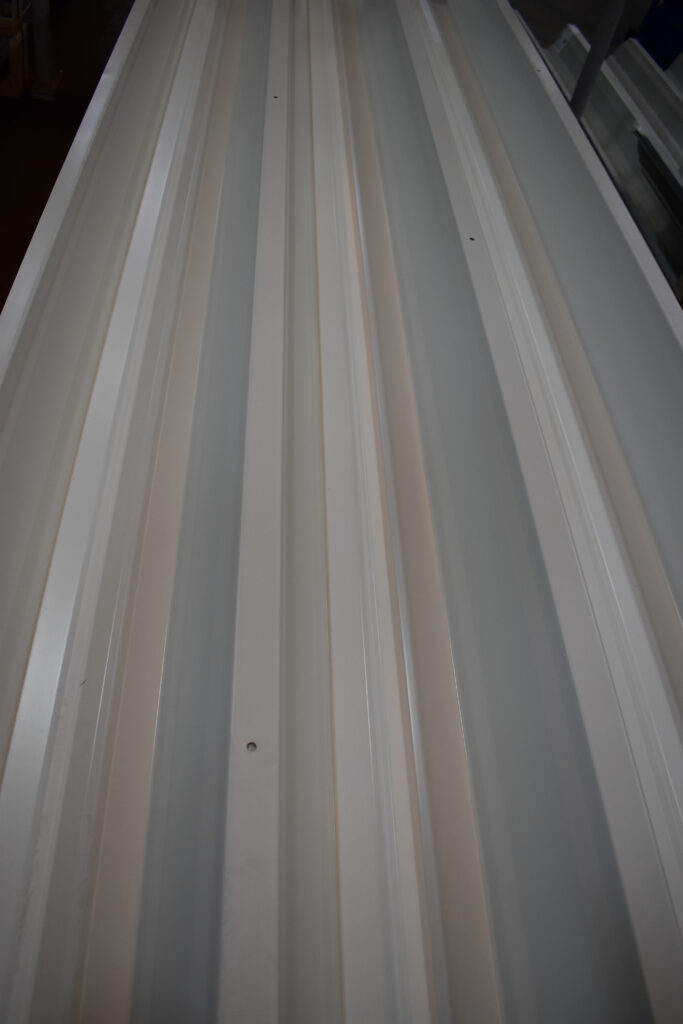
The problem: water accumulation in the cannelures
When a roof remains exposed for an extended period, rainwater can accumulate in the valleys of the profiled sheet (cannelures). Since no drainage system or waterproof layer is yet in place, this water cannot be discharged.
This can lead to:
● temporary water load on the profiled sheets;
● increased load on the substructure;
● risk of deflection;
● risk of corrosion due to prolonged water exposure;
● disruption of the construction schedule;
● unsafe working conditions (slippery surfaces).
In practice, this is sometimes solved by drilling holes into the roof sheets on site to allow water to drain away. However, this is labour-intensive and poses risks to quality and dimensional accuracy.
The solution: factory-applied drainage holes
SAB offers the option to equip warm roof panels with drainage holes. These are applied during the production process and ensure that water can drain from the cannelures.
This prevents water accumulation and eliminates the need for manual drilling on site.
Technical implementation
The drainage holes are applied according to a fixed configuration:
● Centre-to-centre spacing: 1000 mm
● Offset per valley: 300 mm
This positioning ensures effective drainage of the cannelures without affecting the structural performance of the profiled sheet.
Available profile types
Drainage holes are available for the most common SAB warm roof panels:
● SAB 106R+/750
● SAB 135R/930
● SAB 153R/840
● SAB 158R/750
Additionally, application is possible in combination with:
● Perforation L-S
● Perforation L-B
This ensures that perforated applications remain technically feasible in combination with drainage.
Advantages during construction
The use of drainage holes offers several advantages during the construction phase:
- Improved safety: A drier working surface reduces the risk of slipping and unsafe situations.
- Reduced temporary water loads: water is immediately drained from the cannelures, preventing additional load on the profiled sheet.
- Lower risk of damage: preventing water accumulation reduces the risk of material degradation and structural issues.
- More efficient execution: no need for on-site modifications, saving time and preventing errors.
When to apply?
Drainage holes are particularly relevant for:
● large flat roofs;
● distribution centres and logistics buildings;
● projects with phased construction;
● situations where roof panels remain uncovered for extended periods.
For projects where the roof build-up is closed quickly, the necessity is more limited.
Apply drainage holes in your project?
Contact the Product Services department for advice on the right solution for your project. Or consult the SAB Drainage Holes Flyer for additional technical information.