


SAB-profiel › News › Prevent condensation droplets with anti-condensation fleece

Prevent condensation droplets with anti-condensation fleece
DoorLisa Mandjes
Condensation is a common phenomenon in metal roof and façade systems. When warm, humid air comes into contact with the cold surface on the underside of the roof, water vapor can condense. With profiled sheets, this results in condensation droplets forming on the underside of the sheets, which can then drip into the space below.
By applying an anti-condensation fleece to profiled sheets, this issue can be effectively managed and reduced.
How does condensation occur?
Air contains water vapor, the warmer the air, the more vapor it can hold. When air cools down, the relative humidity increases. Once it reaches 100%, condensation occurs. The temperature at which this happens is called the dew point.
For example: at an air temperature of 20°C and a relative humidity of 70%, the dew point is around 14.2°C. When the underside of a profiled sheet reaches or drops below this temperature, condensation will form.
Without anti-condensation fleece
Without protection, water vapor condenses directly on the underside of the profiled sheet. This results in:
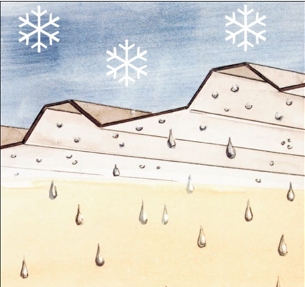
- formation of condensation droplets;
- water running along the surface;
- dripping onto underlying structures or into the space below.
This can lead to unwanted moisture load and material degradation.
With anti-condensation fleece
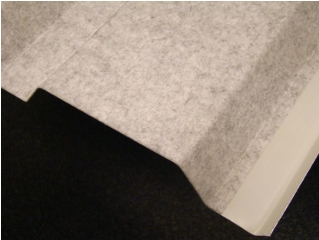
Anti-condensation fleece is applied to the underside of profiled sheets and consists of a fibrous structure capable of absorbing moisture.
Its function is as follows:
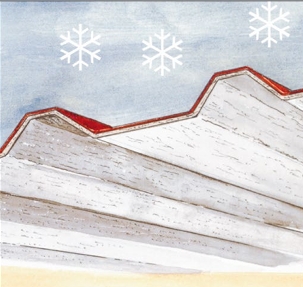
- condensation is temporarily absorbed by the fleece;
- when the temperature rises and ventilation is sufficient, the moisture is released back as vapor;
- dripping of condensation is prevented.
The fleece therefore acts as a temporary moisture buffer.
Properties of anti-condensation fleece
The fleece is made of polyester with a thickness of approximately 0.8–1.1 mm and is applied to the profiled sheet using an adhesive layer.
Key properties:
- Resistance: resistant to bacteria and fungi
- Moisture absorption: up to approx. 900 g/m² (at 0° roof pitch), decreasing at steeper slopes
- Temperature resistance: from -20°C to +80°C
- Fire classification: A2 – s1,d0 according to EN 13501-1
- Sound absorption: reduces noise from rain and hail
Applications
Anti-condensation fleece can be used on:
- cold roof panels;
- warm roof panels;
- façade panels.
Suitable for:
- indoor applications;
- single-skin roofs and façades;
- double-skin ventilated roofs;
- canopies with limited moisture exposure.
Not suitable for:
- areas with permanently high humidity;
- situations without ventilation;
- applications where the fleece cannot dry.
In such cases, absorbed moisture cannot evaporate, limiting effectiveness.
Important considerations during installation
At end laps and sheet edges above the gutter (over a width of 200 mm), the anti-condensation fleece must be post-treated by heating it with a hot air gun so that the fibers locally melt and prevent the absorption of water from the outside.
As an alternative, the fleece can be treated with a water-repellent coating such as clear PVC lacquer.
A practical solution for condensation control
Anti-condensation fleece provides a simple and effective way to control condensation on profiled sheets. By temporarily absorbing moisture and releasing it in a controlled manner, dripping is prevented.
This solution is particularly suitable in situations where ventilation is present and the fleece has the ability to dry.
Additional benefit: sound reduction
In addition to moisture control, anti-condensation fleece also contributes to sound absorption, reducing noise from precipitation such as rain or hail.
Want to learn more about anti-condensation fleece and its applications per profile?
Download the anti-condensation fleece brochure for detailed technical information. Or contact our Product Service department for tailored advice.