


SAB-profiel › News › An effective solution for acoustics in utility construction

An effective solution for acoustics in utility construction
DoorLisa Mandjes
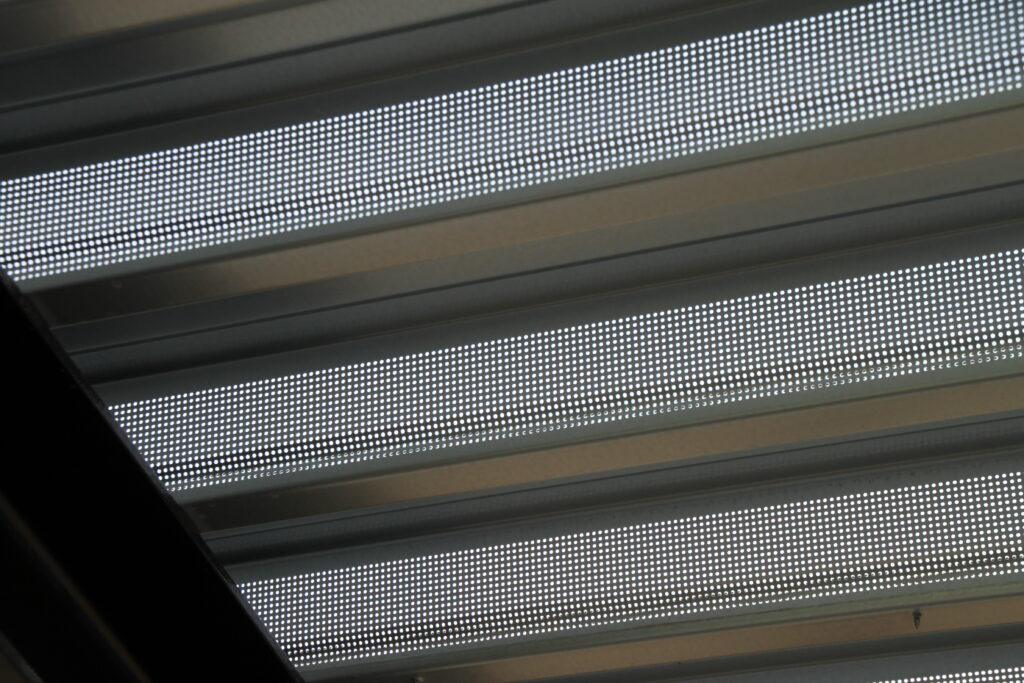
Perforated profile sheets and liner trays are widely used in utility construction where acoustics play an important role. In large halls with hard surfaces and technical installations, sound can easily spread and linger for a long time, directly affecting working comfort and the functionality of the space.
By applying perforation in combination with the right build-up, reverberation can be effectively reduced, creating a more comfortable acoustic environment.
Why perforation?
IIn large steel halls, such as production facilities and distribution centres, a significant amount of noise is generated. Due to the large volume and the use of hard materials, sound can reverberate for a long time.
This results in:
- Reduced working comfort
- Poor speech intelligibility
Perforated profile sheets and liner trays are used to reduce reverberation and improve the acoustics in these spaces.
This application is particularly suitable for:
- Production halls
- Distribution centres
- Workshops
- Spaces with many reflective surfaces
Unlike separate acoustic solutions, perforation is integrated directly into the roof or façade construction.
What are perforated profile sheets and liner trays?
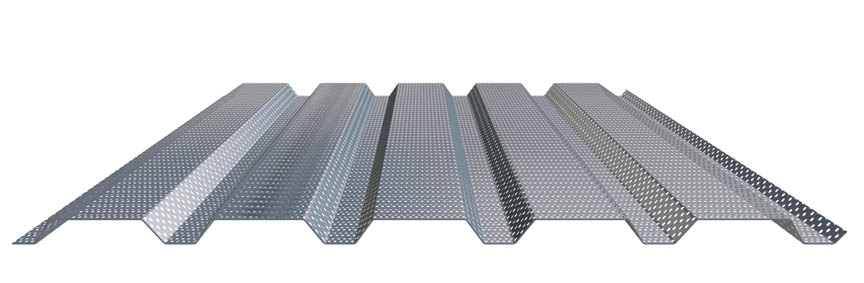
Profiled roof and façade sheets, as well as steel liner trays, can be provided with a perforation pattern when additional acoustic requirements apply. Through the perforations, sound can pass through the sheet and be absorbed by the insulation material behind it, such as stone wool or glass wool.
For warm roof systems, perforation is generally applied only in the web of the profile and not across the entire sheet. This has several reasons:
- Full perforation leads to a significant reduction in structural strength
- A high risk of fixing fasteners being installed at an angle, as they tend to follow the path of least resistance
- When a vapour barrier is applied, perforation in the top flange has virtually no acoustic effect
How does perforation work acoustically?
Sound consists of air pressure waves. In spaces with hard, dense surfaces, sound is strongly reflected, which leads to reverberation.
Perforated sheets provide sound absorption: sound passes through the perforations and is dampened by the insulation material behind the sheet. This concerns absorption within the same space, not sound insulation between different spaces.
SAB‑profiel has carried out extensive testing on both sound absorption and sound insulation of various roof and façade build-ups. The results are included in the technical handbook and provide practical guidelines for design and application.
Roof or façade perforation?
In many situations, roof perforation is the most effective solution. The roof is often closest to the sound sources, resulting in a greater acoustic effect.
When applied in façades or walls, particularly in production environments, contamination can occur, which may reduce acoustic performance over time.
For this reason, roof perforation is often the first solution applied in practice.
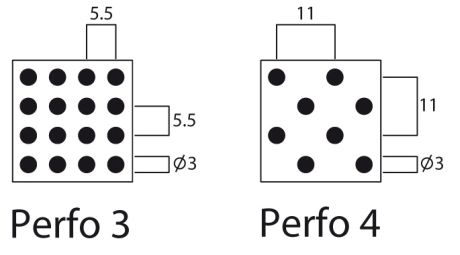
SAB‑profiel supplies two standard perforation patterns:
- Perfo 3 (P3) – perforation rate 23.4%
- Perfo 4 (P4) – perforation rate 11.7%
The higher the perforation rate, the greater the open area and the more sound can be absorbed. Perfo 3 is therefore most commonly used when noise control is a key factor.
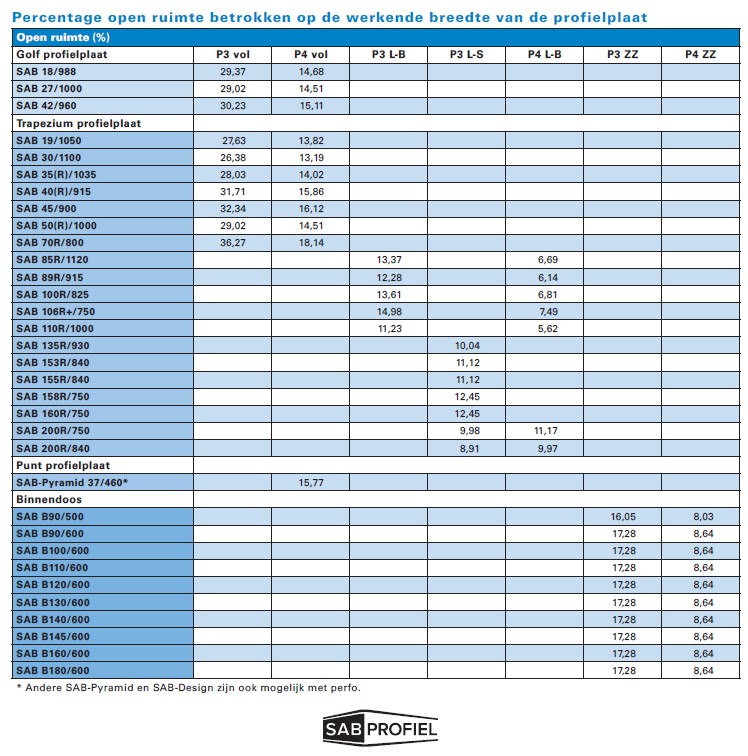
For projects where acoustics play an important role, an acoustic consultancy is often involved. Based on acoustic studies, targeted advice can be given on the required quantity and type of absorption material. The tables with open-area percentages per effective width of the profile sheet, as included in the technical handbook, can serve as practical support in this process.
Table of open area percentages
Perforation options
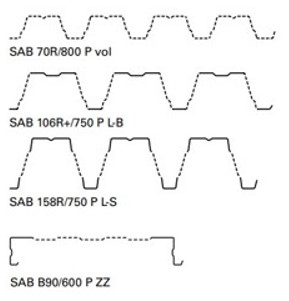
There are several perforation options available, depending on the type of application. For roof and façade sheets, a choice can be made between full perforation (VOL) or web perforation only, executed as (L‑B) or (L‑S). For liner trays, perforation is only possible on the visible side (ZZ). Both Perfo 3 and Perfo 4 are available for all these applications.
Perforation affects the structural properties of a sheet, such as load-bearing capacity and deflection.
For this reason, SAB‑profiel recommends a minimum steel thickness of 0.88 mm for SAB 200R/750 with perforation patterns P3L‑S and P4L‑B.
Note: Applying perforated sheets on both sides cancels out the acoustic performance.
Perforation beyond acoustics: the wind screen at Tata Steel
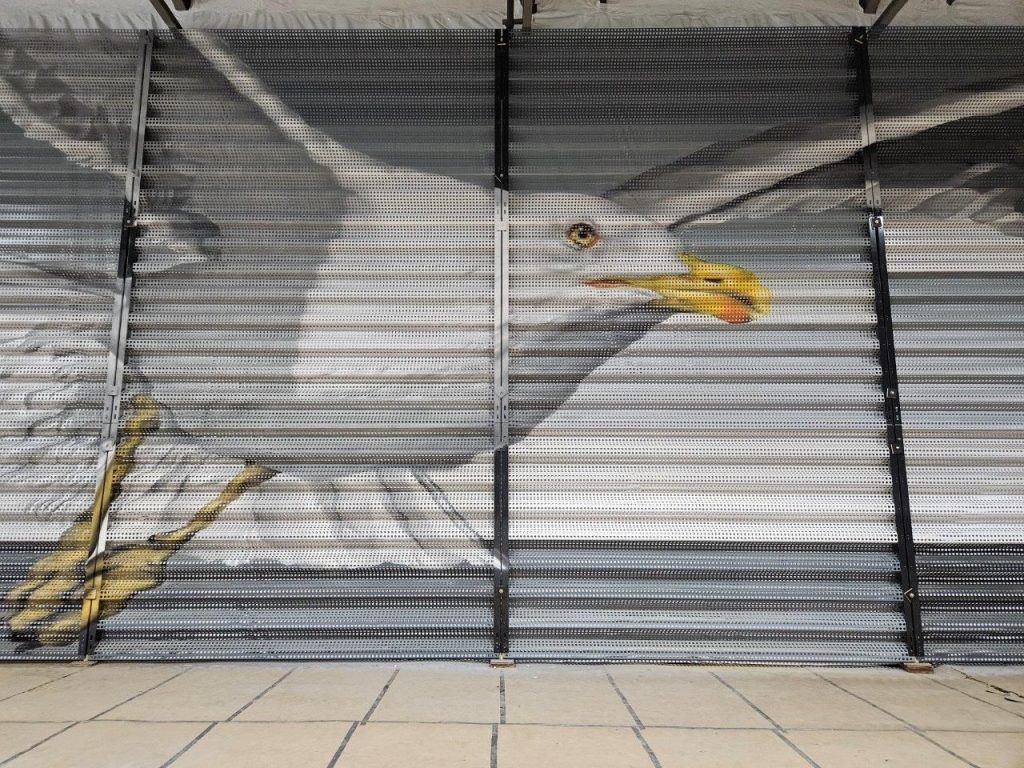
Perforation is not used for acoustics alone. A striking example is the wind screen at Tata Steel in IJmuiden, for which SAB‑profiel supplied approximately 4,800 profiled sheets.
The perforations in these profile sheets were carried out by an external party. The sheets, featuring holes of approximately 3 cm in diameter and a transparency of 44%, were designed to slow down the wind in a controlled manner. This reduces the wind’s impact on raw materials and helps to minimise dust nuisance.
This project demonstrates that perforation can also be applied for airflow control, environmental performance and comfort, in addition to aesthetics and acoustics.
Want to know more?
Curious which perforation solution best suits your project? Contact our Product Services department, they are happy to think along with you.
| +31 (0)30 6879 790 / info@sabprofiel.nl |